
An Historical Sketch of the Portuguese Settlements in China and of the Roman Catholic Church and Mission in China & Description of the City of Canton
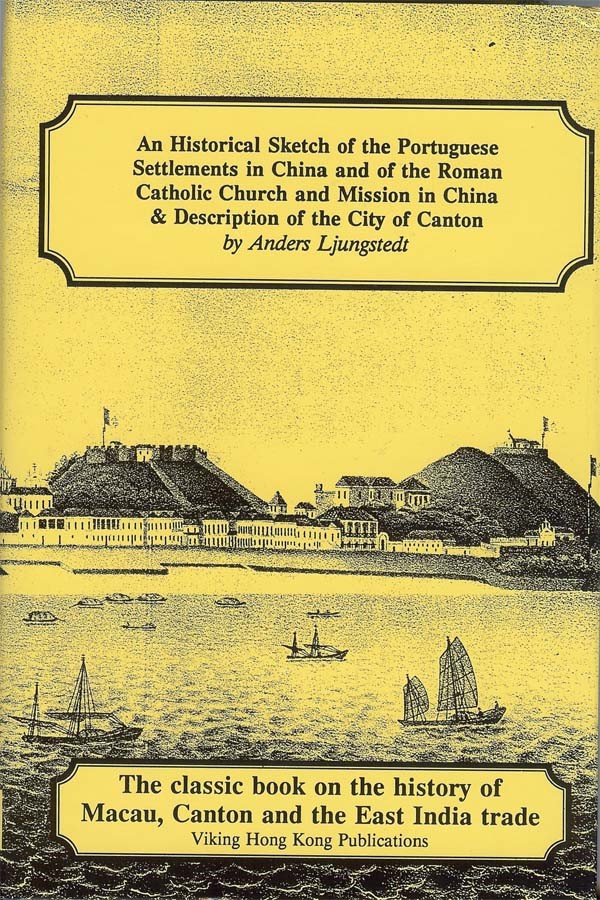
This book by Anders Ljungstedt, or Sir Andrew Ljungstedt as he was called at the time, was first published in Boston in 1836, one year before Ljungstedt passed away in Macao after having spent most of his life that century in the city.
His book was published after a smaller pamphlet was published in Canton in 1832 which had the same principal message: Portugal has no sovereignty over Macao, this is Chinese territory rented by the Portuguese. As Portugal had made the Idea of Portuguese territory its ideology Ljungstedt’s book was like a declaration of war on the Portuguese colonial ambitions.
In his book in 1836 Ljungstedt has collected a large number of documents and written a complete history of Macau from the 1550’s till early 19th century. He mentions in his own foreword that some were destroyed by climate before he had finished the book. It is of course not easy to determine if that is true. He does not mention the fire of the large cathedral of Sao Paolo on 10 January 1835, that has given Macou one of the worlds’s most spectacular ruins. It can therefore be assumed that he had finished the book before 1835.
We published a new edition in 1992 a book that aroused some sensation both in Macao where it was the base of reevaluation of the city’s history. It was decided to name a large street after Ljungstedt and to publish a Portuguese translation (more about that further down). At about the same time a Chinese translation was published and later we also published a Swedish translation.
The chapter about the history of the city of Canton was written by the editors of The Chinese Repository.
The book has been republished in facsimile three times in the US in the years 2005-2011.
The first version of the book ”Contribution to an Historical Sketch…” was published in Canton in 1832 in only 100 copies. In spite of the small number of printed copies, this book was important and made Ljungstedt’s views known. He later revised some details in his final book but the main argument was presented already 1832. Of this edition we only know of one copy in existence, at the Royal Library in Stockholm. We are here publishing scanned copies of this book.


